Humane PA in the Neighborhood

Blog by Humane PA President, Elissa Katz

Elissa and Ginnie  giving animals a voice in their community

Elissa and Ginnie giving animals a voice in their community

This weekend, I spent a morning, along with Humane PA volunteer Ginnie Kintz, tabling at the Roslyn Pet Fair, a fun, well attended annual neighborhood event. Not only did this give me the opportunity to pet a lot of friendly and adorable cats and dogs, but it was a great way to spread the mission of Humane PA among others who care about the humane treatment of animals.

Tabling at neighborhood events has many advantages – in addition to being a fun way to spend some time – it is an effective way to enlist others in your immediate community in our quest of making Pennsylvania a kinder and more compassionate place for our animals.

First, neighborhood events are attended by people in your community, i.e., people you may have seen in the supermarket, pharmacy or on your bus or train commute to and from work – which makes conversation much easier. Numerous people stopped by our table who we have seen on our regular train commute – people who but for tabling at the fair, we would have had no idea had an interest in animals and cared so deeply about animal cruelty issues. We may have exchanged smiles and hellos in the past, but tabling afforded us the opportunity to discuss pending animal related legislation and how to make a difference for animals from a political perspective.

Second, neighborhood events are frequently attended by local politicians, such as commissioners and township office holders. Tabling provides an excellent opportunity to solicit their involvement in promoting a humane agenda.

Third, many local rescues and businesses also table at these events, providing a wonderful platform for networking and exchange of information.

Fourth, tabling enables education: there are many people who do not know what animal related bills are pending and how to get involved. And, although Humane PA works very hard through social media and other venues to engage the public in the process, there are still many people who care about animals who are unaware that there is a statewide group committed to improving the lives of animals by electing compassionate lawmakers and passing humane and protective laws.

Finally, by tabling at a local event, you can help build the power of the animal vote in your very own backyard – the more people in your district who contact the district state representative and senator in support of humane legislation, the more likely that elected official is to be responsive and to be a voice for animals in Harrisburg.

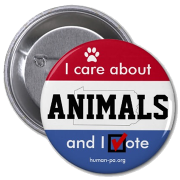
Many people stopped by our table at the Roslyn Pet Fair. They asked questions about what bills are pending and which legislators support humane legislation. They signed up to receive the Humane PA newsletter and action alerts. They picked up fact sheets on pending bills. They picked up and pinned on their shirts the “I Care About Animals and I Vote” Humane PA button. And, while Ginnie and I were enjoying the morning and fussing over lots of beloved pets, we were also increasing the engagement of others who care about animals to join with Humane PA to end cruelty to animals in Pennsylvania.

I encourage everyone to consider tabling at events in your own neighborhood. Humane PA will be happy to provide you with the necessary materials and guidance to do so as well as tabling tips and guidelinesHumane PA’s Flyer and Post Card can easily be printed from our website too. Together, we can and will make Pennsylvania a kinder place for animals.

katz_fullElissa B. Katz is the President of Humane PA and a partner in the law firm of Meranze, Katz, Gaudioso & Newlin, P.C. in Philadelphia. She is a regular volunteer with the Philadelphia Animal Welfare Society (PAWS), assisting with cat care and adoption applications at an adoption site.  She is also a board member of The Humane League.

Posted in Animal cruelty, Animal Law, Community outreach, Pennsylvania legislation, Uncategorized

Be a “Super-Voter!”

Be  a “Super-Voter!”     supervoter3

Blog by Humane PA President, Elissa Katz

Are you tempted to skip the May 21st Primary Elections? I know I am! After all, it’s only a primary and there are no statewide or federal offices up for consideration. And, we’re all tired at the end of the work day, so it may not seem worth it to stop at the polls. But, voting this Tuesday,  May 21 is important, so don’t give in to the temptation to go straight home after work. In fact, voting, or not, on May 21st could make the difference as to whether or not you are considered a “super-voter.”

A “super-voter” is a voter who votes in every election. Who pays attention to this? Political parties and candidates and elected officials – the people who are directly involved in policy and law making – the very people we want to care about animal and humane issues. Candidates target “super-voters” in their state, county, township, or district races at election time because they know that a “super-voter” is going to get to the polls on election day – every election day – and cast a vote for someone, and they want to be that someone. When a constituent calls their elected officials about a particular bill, seeking support or opposition, many legislators check their data-bases to see if the caller votes, and the legislator will know that a “super-voter” is someone who will respond to a candidate’s position at the polls. Simply by voting in every election – regardless for whom or what party – elevates you to “super-voter” status – and that increases the weight of your opinion, stature and voice to candidates and parties.

Our Voter Resources page has links to information about voting and lists of candidates running for various municipal offices. And, while Humane PA endorses only candidates for state office, it is very important that we all contact candidates for local office to let them know how important humane issues are and to ask where they stand on improving policies affecting animals. Many candidates will be at polling locations on election day, where you can introduce yourself and ask them their position on animal protection. We each can be the person who puts animal issues on a candidate’s radar screen early in their careers.

So, be a “super-voter” and get to the polls on May 21st! It is one more way – and an easy one at that – to increase the power of the animal vote.

katz_fullElissa B. Katz is the President of Humane PA and a partner in the law firm of Meranze, Katz, Gaudioso & Newlin, P.C. in Philadelphia. She is a regular volunteer with the Philadelphia Animal Welfare Society (PAWS), assisting with cat care and adoption applications at an adoption site.  She is also a board member of The Humane League.

Posted in Animal cruelty, Pennsylvania election, Pennsylvania legislation, Politics

Time to Make New Friends is Now!

What does redistricting mean to you?

Guest blog by Senator Roy Afflerbach, Ret.

confused

After the 2014 Legislative Elections, many Pennsylvania voters will be represented by someone new, because their district will have changed. The district boundary changes approved by the Supreme Court this week mean that some people will have a new legislator. Now is the time to plan to make new friends with potential legislators…or maybe even consider seeking election to the in a newly configured district.

Who is going to represent me?

The first thing to do is to check your voter registration card to verify which voting municipality precinct or local district you reside. If you can’t find your voter registration card, you can contact the voter registration office in your county find out which municipal local voting district you are in.

Next, consult the “Legal” description of the new Legislative Districts. There is a link to the Interactive District maps at
http://www.theafflerbachgroup.com/
. The new districts are listed in numerical order, and include the municipalities currently within that district. In cases where municipalities are divided, the local municipal voting districts will be specified in the Legislative District Legal Description.

Now you can can look at either the House or Senate interactive district map link on the Afflerbach Group site to compare the new district with the present district. The maps provide an overlay of the present and new district configuration for each district. If you are in both, your legislator will not change unless he or she chooses not to seek reelection, or is defeated.

If you do not reside in both the present and the new configuration, you will have a new legislator after the 2014 elections. For example, the 40th Senatorial District will be moved across the state and its present configuration will be divided among other Senatorial Districts. Therefore, everyone residing in the 40th District will be represented by a new Senator.

Check back next week  for the next Humane PA blog covering the next step toward making a new friend – and how to be a “Super-voter!”

AFF_bio~~element20

In addition to being a co- founder and Treasurer of Humane PA PAC, Senator Roy C. Afflerbach, Ret. is founder and President of The Afflerbach Group, LLC.

Several of these district changes may be affecting legislators who are supportive of humane legislation.  We will be keeping a close eye on their voting records this session, as well as who declares as a candidate.  More info from Politics PA about what races may be the most affected by re-districting: Redistricting Aftermath: Potential Member Vs. Member Battles

Posted in Legislation, Pennsylvania legislation, Politics, Uncategorized

Dinniman and Philly Dawg talk animal issues on PCN

Amy Worden writes the Philly Dawg blog for The Philadelphia Inquirer. With her permission we are reposting her blog here about PCN dedicating a call-in show to the topic of animal welfare! Congratulations to Amy Worden and Senator Andy Dinniman!

156682_10151267757156405_1347119069_n (2)       Amy_Worden

Dinniman and Philly Dawg talk animal issues on PCN

petsAmy Worden, Inquirer Staff Writer

The plight of dogs in puppy mills, the finances of the dog law enforcement office, legislative efforts to protect animals and their people from harm were among te wide-ranging topics Sen. Andy Dinniman and I discussed on Pennsylvania Cable Network’s call-in show last night.

It was the first time in recent memory that PCN has dedicated the call-in show to the topic of animal welfare and boy did we have a lot of ground to cover.

Dinniman, of Chester County, who won the distinction of humane legislator of the year from Humane PA, led the fight for “Daniel’s Law,” which ended the use of gas chambers in Pennsylvania shelters.

We talked about a host of hot topics: how to address the sheltering crisis in the state, the role of pets in domestic violence cases, the need for expanded accommodations for therapy pets who travel in public with their human partners – and took questions from a statewide audience.

Philly Dawg would like to thank PCN for dedicating the time to animal issues and for including your faithful pet blogger in the discussion. With somewhere in the neighborhood of two dozen animal-related bills percolating in the legislature right now, we hope there will be an opportunity to revisit the issue in a future broadcast..

To watch the show click here.

Amy Worden is a politics and government reporter for the Inquirer. In that capacity she has explored a range of animal issues from dog kennel law improvements and horse slaughter to the comeback of peregrine falcons and pigeon hunts. From hamsters to horses, animals have always been part of her life.

Keep updated on current legislation affecting animals in Pennsylvania.

Posted in Animal cruelty, Animal law, Animal Law, Legislation, Pennsylvania legislation, Politics, Uncategorized | Tagged , ,

The Importance of Animal PACs – an Insider’s View

Guest blog by Alexis Fox, Massachusetts Voters for Animals

logo10

Thank you, Humane PA, for unleashing voter power to build a compassionate world!  I believe that there will be a day when we can applaud a legal system that stands firmly between animals and those who want to abuse them. Our country’s progress will move to a time when the values of the animal protection movement are on equal footing with values championed by the women’s rights movement, the civil rights movement, and the environmental movement.  I am regularly comforted by Martin Luther King Jr.’s assurance that “The arc of the moral universe is long, but it bends toward justice.”
Yet, the fierce urgency of now remains. Billions of beating hearts depend on us to be effective, to expedite our efforts and to use all of the power that comes with citizenship in our democracy to be their voice.
Alice Walker famously wrote that “The most common way people give up their power is by thinking they don’t have any.” Too often I hear from animal advocates who do not truly understand the power they wield as citizens. As citizens, we have tremendous power as constituents and voters. When we exercise this power we can, and do, pass legislation that protects animals from abuse. These laws create a protective barrier around otherwise vulnerable animals. Yet animal protection laws do not get passed without the active support of lawmakers who care about animals. The fight on behalf of animals is not always an easy one. There are strong lobbies working at State Houses throughout this country to fight any attempt to regulate interactions between people and animals. They fight to be able to do whatever they want to animals without concern for their well-being.
When lawmakers stand up to these powerful lobbies on behalf of animals, we as citizens must stand up for those lawmakers. These lawmakers expect and deserve our support on Election Day. If you care about animals and you want to help them, it is incredibly important that you tie your vote to your care and concern for animals.
Humane PA is a fabulous Political Action Committee (PAC) that inspires animal advocates to become engaged voters. As voters, we must support lawmakers who stand up for animals. We should show our gratitude for their compassion by voting for humane candidates, donating to the PAC, volunteering for humane candidates’ campaigns, and organizing key districts.
Humane PA also holds lawmakers accountable when they spend political capital to enact laws that are harmful for animals, or when they block important animal protection bills. As a movement, we must be able to show legislators that it is in their political self-interest to do the right thing when animal protection bills come their way. Humane PA is the political voice for animals in the Commonwealth. That means Humane PA is holding candidates accountable at the polls, and is inspiring other state PACs throughout the country to do the same.
With an impressive social media operation, Humane PA reminds all of us that democracy is not a spectator sport. Leadership tells us that if we care about animals, we need to get in the game and use our power as voters to put compassionate lawmakers in office. Whether touting the latest opportunity to volunteer for a campaign, raising funds with an impressive donation match campaign, or reminding us to thank humane law makers, Humane PA truly gives animals a voice in Harrisburg. Humane PA shows all of us how we can build strong state PACs throughout the country, so that every state has a similar PAC.
Last year I was privelaged to attend the Democratic National Convention in Charlotte. I was one of twenty-two thousand Americans in that enormous stadium where Bill Clinton, Michelle Obama, and President Obama spoke. In that stadium, the crowd demonstrated tremendous enthusiasm for ideas that were once highly controversial.  We felt the roar of applause for a black President. And in that stadium, I could almost hear future convention crowds cheering for animals. I know that when every state has a PAC like Humane PA, we will be there. We will have arrived at a place where candidates and stadium crowds enthusiastically applaud the proud work of building a legal system that protects the vulnerable lives that share our world.
Thank you Humane PA for all you do to empower and inspire!

390837_2554910305984_1586658287_n

Alexis Fox is with Massachusetts Voters for Animals. MVFA

Posted in Animal cruelty, Legislation, Politics, Uncategorized

The Pennsylvania Boar Wars – confused?

both billsFollowing a single bill through the legislative process  in Pennsylvania can be confusing to say the least;  but to have two identical bills move through both the House and Senate at the same time, and then be taken on and off the voting calendar, can make even a PA political geek’s head spin.  Fortunately we have a few political geeks here at Humane PA and we’re going to try to break down the process as best we can.  We have also included a link at the end so you can get the facts about how both of these bills will impact not only animals but also our environment.  Ready?  Okay, here goes, so pay close attention.

SB 644 is the Senate Bill.  It has passed the full senate, first consideration in the House and then was re-committed to House Game and Fisheries Committee where it is expected to be amended and if passed will be voted by the PA House of Representatives. Therefore, you need to contact your state representative to ask them to OPPOSE SB 644.  If it passes without amendment, it will go straight to the Governor and become law.  If amended, it goes back to the Senate  to be voted on concurrence and then on to the Governor.

HB 723 is the House Bill.  On April 9,  HB 723 passed the full PA House 101-100, so it goes to the Senate Game and Fish Committee.  Once it passes the committee, it goes to the full PA Senate for a vote. Please contact your state senator to ask them to OPPOSE HB 723.

This bill as is being fast-tracked and is in response to the Pennsylvania Game Commission (PGC) proposing regulations to eliminate the importation and ownership of wild boars in canned hunts.  The PGC proposal will aid in the reduction of future destruction of the habitat by feral hogs that escape too frequently from these hunting operations. SB 644 and companion House Bill, HB 723 will take jurisdiction (over wild boars when held in captivity) away from the PGC,  which will then prevent the PGC from shutting down these risky canned hunting operations.  Canned hunts are the number one source of escaped wild hogs that ravage our wild habitat!  Please take a look here for more facts about the bills: Fact sheet: HB 723 and SB 644 to Deregulate Feral Pig Captive Hunts

We at Humane PA thank you all so much for your vigilance and willingness to help, especially when a bill is this confusing. PA legislators are commenting more and more on how well we are staying on top of this bill.  It is a real testament to the dedication of the animal vote that our desire to help animals motivates us to navigate our way through the confusing legislative process in PA!

Learn more about the Path from Idea to Bill to Law in Pennsylvania

New York Times: When One Man’s Game Is Also a Marauding Pest

Posted in Animal cruelty, Legislation, Politics

Are Ag-Gag Bills Coming to Pennsylvania?

Christin Bummer

Christin Bummer

Congratulations to Humane PA Western Coordinator, Christin Bummer, for the publication of the opinion piece she co-authored in the Pittsburgh Post-Gazette about Ag-Gag (anti-whistleblower) bills which are cropping up across the country, including Pennsylvania (HB 683).  Thankfully, there have been no hearings on the PA bill, but we will alert our members the second we get an inkling it may move.  Read Christin’s piece below.

logoThe secrets of meat: Pennsylvania should support investigations of abusive farms,

By Jeffrey Cohan and Christin Bummer

There is a joke making the rounds that would be pretty funny if it didn’t convey a serious truth.

It goes like this:

How many meat-industry executives does it take to screw in a light bulb?

The answer is zero. They want to keep you in the dark.

The vast majority of pigs, chickens and turkeys are confined in cramped warehouses, far removed from public view. Undercover animal-welfare investigators have been able to document horrific abuses and food-safety problems inside many of these factory farms, including some in Pennsylvania.

But rather than reforming themselves to eliminate such abuses, the meat, egg and dairy industries are trying to double-down on secrecy with so-called “ag-gag” legislation, bills that seek to outlaw those undercover investigations.

Such bills have already passed in at least five states and now ag-gag legislation has been introduced in Pennsylvania. House Bill 683, which is awaiting a hearing in the House Judiciary Committee, would make it a felony to record an image inside a factory farm without the owner’s consent or to disseminate such an image over the Internet. Freedom of speech be damned.

We should know where our food is coming from. But where these bills have passed, undercover investigations have virtually ceased, eliminating a main source of protection for farm animals and blinding the public to what is happening inside these massive animal warehouses.

It would be different if the government was willing and able to regularly investigate food-safety and animal-abuse problems in today’s industrial-scale agriculture. But in reality, the government is dependent on nonprofit animal-welfare agencies to initiate investigations and gather documentation.

For instance, it took an undercover Humane Society of the United States investigator to reveal shocking cases of abuse and unsanitary conditions at a Lancaster County egg facility of Kreider Farms. The investigation, featured on “ABC World News” last year, found dead chickens rotting among egg-laying hens and found other hens trapped in cage wires and feeding machinery.

As a result of another Humane Society investigation last year, nine workers at a Wyoming pork processing facility have been charged with animal cruelty after a video showed them kicking and tossing piglets and failing to euthanize a sow who was gravely injured by a worker while giving birth. Thankfully, the Wyoming legislature had the good sense to reject its own ag-gag bill, as have the legislatures in Arkansas, New Hampshire and New Mexico.

Leading newspapers from coast to coast have railed against the bills. For example, the Los Angeles Times called California’s ag-gag legislation “disturbing,” while the Nashville Tennessean opined that agribusiness seems more concerned about getting caught than about eliminating abuses.

Still, such bills continue to pop up in state after state.

Some factory-farm operators claim that the undercover investigations infringe on their privacy rights. But their protest rings hollow, especially when you consider that only a tiny fraction of such farms are ever investigated. Wouldn’t everyone be better served — consumers, farm animals and even the farmers themselves — if agribusinesses cleaned up their act rather than hid their operations behind an iron curtain of secrecy?

Indeed, looked at from the point of view of farmers, the ag-gag bills actually appear self-defeating. Acting like they have something to hide creates the appearance that they really do have something to hide. This is a public-relations fiasco and puts farmers on the wrong side of a First Amendment freedom-of-speech battle.

One would hope that meat, dairy and egg operators would answer to their better angels, do right by the American public, reform their practices and withdraw their support for the bill.

But because that doesn’t look like it’s going to happen anytime soon, please contact your representatives in the state House and ask them to reject H.B. 683. Visit http://www.PAHouse.gov to find out who your representative is and how to contact him or her.

Jeffrey Cohan, a resident of Forest Hills, is executive director of Jewish Vegetarians of North America. Christin Bummer is owner and CEO of K9 Kingdom in McCandless.

Fact sheet:   HB683, Ag-Gag: Stop Agribusiness’ Attempt to Suppress Whistle-Blowing over Animal Cruelty, Food Safety Threats, Worker Abuse, and Pollution Continue reading

Posted in Animal cruelty, Animal law, Legislation, Politics, Uncategorized

Politics and Animals – The Missing Link

Blog by Humane PA President - Elissa Katz   voice 5
When we think about animal protection, welfare and rights, and the best way to help animals, our minds often immediately focus on rescue, foster, spay/neuter, humane education and other direct actions that have a sense of urgency and can yield tangible results. Such activities are so critical. The sheer numbers of animals in need can be overwhelming and exhausting. It feels good to look at the faces of the ones who have been saved and spared a tragic fate. And, there are few better feelings than matching the perfect adopter with an animal in need.
When we think about helping animals, rarely do many of us think in political terms. Yet, to be a well rounded, effective movement and to help as many animals as possible, those of us who care about animals must be players in the political field. We must be a strong political force, insisting upon the passage of laws that will protect animals and prohibit cruelty. Without anti-cruelty laws, we will always be struggling against the tide. Those who oppose reform and protection of animals understand this, and they have worked for years and years to establish a unified front and strong political presence in Harrisburg. They know and are known by the legislators and political parties. Until fairly recently, the “animal” voice in the political arena has been the missing link in our arsenal of anti-cruelty tools, and it is time for us to catch up.
There is no doubt that the political process is fraught with frustration. Promises are made – and broken. Legislation is introduced, and sits, and sometimes dies in committee. Bills that could be so helpful to reducing cruelty to animals are not given the votes they deserve. It can take a long time, sometimes a seemingly ridiculously long time, for even a popular bill to make its way through the process and to be enacted into law. But these frustrations cannot serve as a basis for us to be outsiders to the process and ignore the good that can arise from political strength. The reality is that we need better and more laws to protect animals and that if we don’t jump right into the thick of it and become a stronger political force, we won’t get what the animals need. The animals we seek to help can’t participate in the process, but we can, and must, on their behalf.
While Humane PA is relatively young in the life of politics, if we take a step back, we can see that progress has been made. In our 6 years of existence, we have grown from a handful of voting constituents to over 24,000. In the last election cycle, numerous candidates contacted us, completing our questionnaire and seeking our endorsement. We were able to support candidates who support humane legislation. And while not every candidate we supported was elected to office, many were. Humane PA activists were out in the trenches, distributing campaign literature, door knocking, working polls, contributing, and otherwise supporting humane candidates. Humane PA representatives and coordinators are attending town halls, political events and meeting with their legislators, and are making a difference for animals.
The opening months of the 2013-2014 legislative session has seen the introduction of a record number of bills to protect and improve animal welfare including, but not limited to, anti-tethering, banning the use of live animals for target shooting competitions, prohibiting the possession of animal fighting paraphernalia, increasing penalties for violations of animal cruelty laws, addressing the cost of care of seized animals, and banning the sale of shark fins. And, while it is exciting to note the wide range of animal related bills introduced so far, we need to pull out all the stops to make sure that these bills move, receive votes, pass, and are enacted into law. We need to be a strong and ever-present voice in Harrisburg reminding our elected officials that we expect them to support and work for the passage of these and other bills concerning the humane treatment of animals, and that our vote is contingent on such.
At Humane PA, we believe that a strong political presence can no longer be the “missing link” in the arsenal of tools we employ to battle cruelty and to achieve the humane treatment of animals. We must collectively insist upon more and better laws, continually chipping away at cruelty. Political commitment and involvement must be elevated to equal ground with all of our other anti-cruelty activities so that we can effectuate broad based positive change for animals. Given our progress to date, there is good reason to hope for better for animals – it is clear that while change may not be as fast as we might like, it is coming. Please join us at Humane PA to make it happen.

katz_fullElissa B. Katz is the President of Humane PA and a partner in the law firm of Meranze, Katz, Gaudioso & Newlin, P.C. in Philadelphia. She is a regular volunteer with the Philadelphia Animal Welfare Society (PAWS), assisting with cat care and adoption applications at an adoption site.  She is also a board member of The Humane League.

Posted in Animal cruelty, Legislation, Politics

Hope for Our Future

Humane PA is reposting a great opinion piece from the Lancaster Sunday News by 10th grade student, Rachel Rusch, who stands against animal cruelty, whether it is puppies or pigeons – a lesson many of our legislators could take to heart. Congratulations Rachel. You are a great example of compassion and leadership and you give all of us hope for the future.               pigeonshoots

IN MY OPINION
Pass a law to ban live pigeon shoots What’s your opinion?
By Rachel Rusch, Special to the Sunday News
Animal abuse is a terrible thing, and very much illegal. Or is it? Pigeon shooting is a popular sport here in Pennsylvania. But these shoots should be labeled as animal cruelty as they do not prove any type of sportsmanship for the shooter. It is an unfair game.

Pigeons are raised or captured, often illegally, and are kept in cramped cages where they barely have room to move or breathe. These poor birds are starved for days before being carted away to their doom. At the hunting clubs, they are strapped into a catapult and launched into the air.

With their equilibrium off-balance, they have no chance to escape and are shot down. Shotgun pellets often do not kill the pigeons right away, and the poor birds are left flapping and struggling on the ground until life leaves them. Some birds aren’t lucky enough to be dead before the trapper boys pick them up, snapping their necks and wings. As if that isn’t enough, the dead birds are often used for games like kickball.

When the children have had their fun, the corpses are tossed into piles, and any remaining living birds are suffocated.

I can attest to this. A few years ago, I lived five minutes from a hunting club that regularly supported this sick game. I remember looking out the car window and watching it happen in front of me. It was traumatizing.

While pigeons are often referred to as rats of the air, they were successfully used in World War II to deliver crucial messages for help when there was no other way to communicate. Pigeons were valued by soldiers whose lives were saved.

The tradition of pigeon shoots is too cruel to be continued. Clay discs can easily be used in place of live birds. Pigeon shooting not only harms innocent life, but it also teaches children who watch that animal abuse is OK.

The shooters are not chasing down the bird in its natural environment, and the practice does not exemplify sportsmanship. There’s a difference between that and setting up an already weak animal to be massacred.

I strongly encourage you to write to your local senator and persuade support for state Senate Bill 510, which would ban this cruel practice. Do not worry that it will change hunting laws.

In a memo to colleagues announcing introduction of the bill, state Sen. Patrick Browne, R-Lehigh County, wrote, “The legislation would prohibit the use of live animals or fowl for target trap shoots and block shoots. A trap shoot involves immediately launching a moving target and a block shoot involves a tethered or stationary target. An individual who willfully organizes, operates or conducts one of these shoots commits a summary offense.”

He continued, “This legislation will protect legitimate hunting activities in the Commonwealth but will also prevent the use of live animals or fowl for purely target practice activities.”

In other words, it does not have any effect on people who hunt game animals in their natural habitat. So please, find out if there is a hunting club in your county that supports pigeon shoots, and if there is, write to your senator. Pigeon shoots should be labeled as animal cruelty.

Rachel Rusch, 15, of New Holland, is a 21st Century Cyber Charter School 10th-grader who wrote this piece for a class speech project. She plays violin in the Garden Spot High School orchestra.rusch

Posted in Uncategorized

CAN YOU SPARE TWO MINUTES?

Blog by Humane PA President, Elissa Katztwo minutes

I care deeply about the humane treatment of animals – and I know that you do too. That is why we belong to Humane PA and why we are fighting for the passage of laws that will protect animals. But, sometimes our fight can seem overwhelming – there is so much to be done, how do we properly allocate our time and resources in the best way possible to help animals? Most of us are already helping animals in so many ways. We volunteer for shelters and rescues, we foster, we engage in TNR, the list goes on and on. And, on top of our various volunteer activities, we have jobs and family obligations. And, while we want laws to be passed to help animals, how can we find time to do it all?
As president of Humane PA, I have come to realize that sometimes all it takes is two minutes to make a difference. Here are some actions which can be accomplished in literally two minutes, and these are actions which can make a meaningful difference when we are trying so hard to enact humane laws:
1. Every time you receive an action alert, call or email your legislators’ office to express your opinion. To save time, program your legislators’ telephone numbers into your phone and their email addresses into your contacts. When a piece of humane or animal-related legislation is coming up for a vote, it will take less than two minutes to first call your legislator and ask him or her to support (or oppose) a specific bill and to follow up the telephone call with a quick email. It takes less than two minutes of our time to let our respective legislators know that we are watching how they vote and that we want them to support humane legislation and oppose bills that are bad for animals. Our legislators care about and respond to our input, since we are their voters and can determine whether or not they remain in office at election time.
2. “Like” Humane PA posts on Facebook. If possible, post a short comment. That will help keep Humane PA posts prominent in the Facebook feed, which in turn ensures that the posts will be seen by more people.
3. Share Humane PA Facebook posts on your own Facebook pages. By doing so, this action which takes less than two minutes, will be multiplied exponentially as the post is seen by your own Facebook friends.
4. Sign up to receive the Humane PA enewsletter and email alerts. Receiving the newsletter and alerts will help you to stay informed as to the status of pending animal-related legislation in our State.
5. Forward the Humane PA enewsletter and action alerts to your friends, encouraging others who care about the humane treatment of animals to take action.
Raising our voices on behalf of animals and making our opinions known to our State lawmakers does not have to take a lot of time. Getting better laws passed and reminding our legislators that we want them to pursue a humane agenda does not have to overburden our already busy and sometimes overwhelming schedules. There are more animal-related bills under consideration in our State legislature than ever before. Can you spare two minutes to take action? Sometimes, that’s all that it takes to make a difference in the lives of animals.katz_full

Posted in Uncategorized